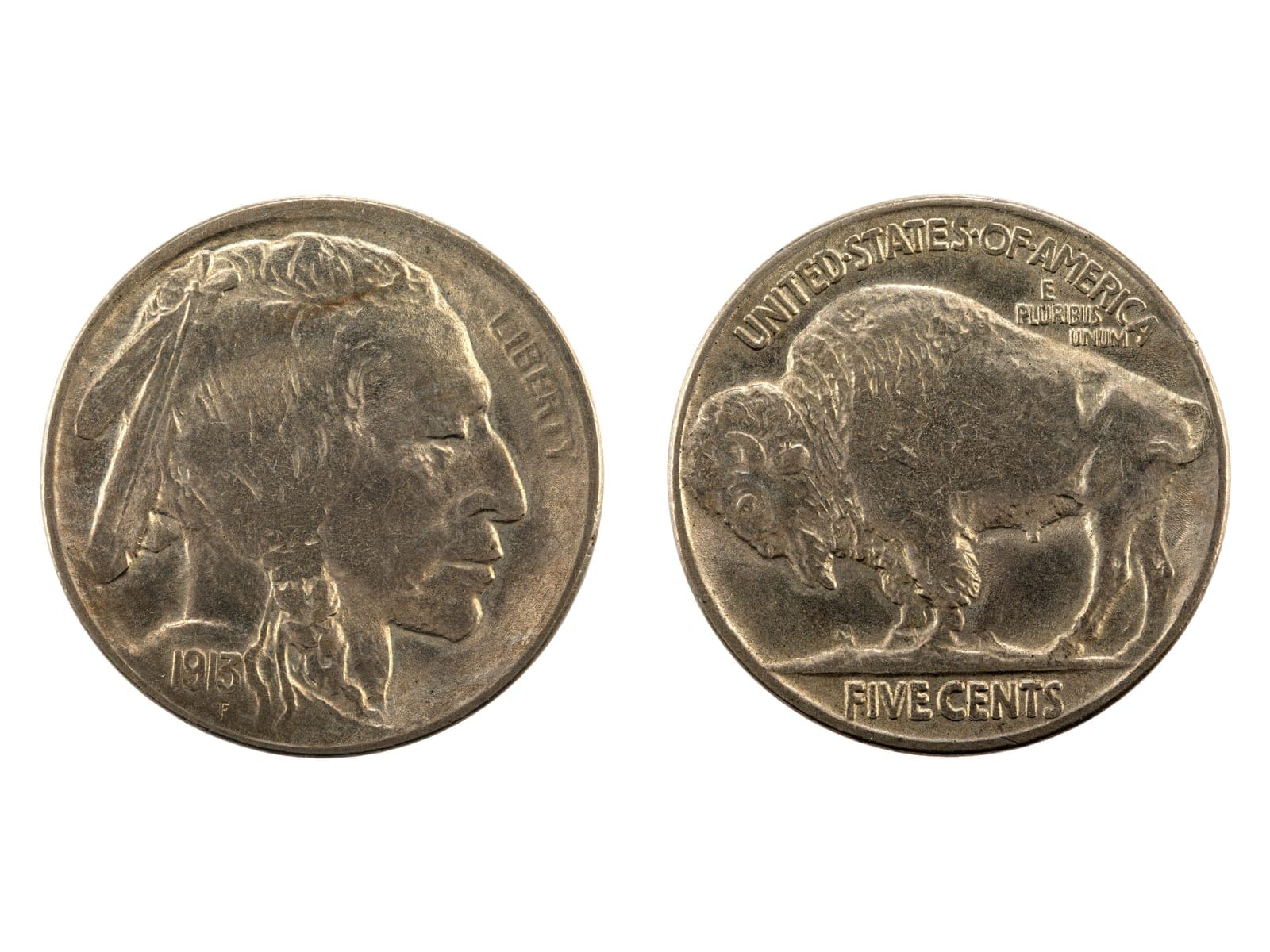
Quick facts
- Motto
- No IN GOD WE TRUST on either side[12]
How to identify a Buffalo nickel with a phone in hand
Every coin in the series shares the same two designs, so identification is really about reading three small details: the ground under the bison, the space below FIVE CENTS, and the date on the portrait's shoulder. Do them in that order, with the phone's zoom on.
- Look at the ground under the bison. A raised mound with FIVE CENTS sitting on top of it is the 1913 Type 1. A thin straight line, with FIVE CENTS in a recessed strip below it, is Type 2, which runs from later in 1913 to 1938.
- Look directly below FIVE CENTS. A tiny D means Denver, an S means San Francisco, and no letter at all means Philadelphia. The mark is small enough that a loupe or a cropped photo helps.
- Find the date on the shoulder, just below the neck. It sits on a high point of the design, so on a worn coin it fades before almost anything else.
- Find the small F under the date. That is Fraser's initial, not a mint mark; the only mint marks on this coin are D and S.
- Check LIBERTY at the upper right. It arcs just inside the rim by design, and on worn coins the rim grows into the letters. That is wear, not an error, whatever a listing title says.
- If you have a scale, weigh it: 5.0 g and 21.2 mm across, plain edge. Two fakes NGC has published weighed 4.44 g and 5.4 g.[1, 3, 5, 6, 8, 14, 16, 21, 22, 23]
Often confused with
2005 Jefferson nickel, American Bison reverse
A bison on the back but Thomas Jefferson on the front and the date 2005. It is a Jefferson nickel from the redesign series the Mint ran in 2004 and 2005, and Denver alone struck 487,680,000 of them.
2001 American Buffalo silver dollar
Fraser's design revived on a 38.1 mm, 90% silver coin marked ONE DOLLAR and dated 2001. A nickel is 21.2 mm and grey.
American Buffalo gold coin (2006 onward)
Fraser's portrait and bison on a .9999 gold bullion coin, 32.7 mm across, with $50 and 1 OZ on the mound and a date of 2006 or later. If it is yellow and heavy, it is not a nickel.
Hobo nickel
A real Buffalo nickel that someone carved by hand, most often turning the portrait into a man in a derby hat. Carving marks and a changed profile give it away.
Oversized novelty replicas
Google Lens matches for our users' photos include 3-inch 'jumbo' souvenir versions. A genuine nickel is 21.2 mm; anything bigger is a toy or a paperweight.
Why the design changed within its first year
James Earle Fraser grew up in South Dakota and slept on buffalo skins as a child. He later said the portrait combined three men who had posed for him: Iron Tail, an Oglala Sioux chief, Two Moons, a Cheyenne chief, and Big Tree, a Kiowa chief. The animal on the back is a bison, not a buffalo, and the sources disagree on the model. Numista and CoinWeek place Black Diamond, the bull Fraser named, at the Central Park menagerie; CoinValues says the Bronx Zoo. Treat it as a good legend rather than a fact.
Philadelphia struck the first coins on February 17, 1913, and they reached the public on February 22. Within months the Mint saw that FIVE CENTS, sitting on top of a raised mound, was wearing away fast. Chief Engraver Charles Barber cut most of the mound away, leaving a horizontal line and a recessed strip for the words. Those later 1913 coins are Type 2, and the design stayed that way until 1938. The date on the obverse was just as exposed, and nobody protected it, which is why so many survivors have no date at all.
A rumor that the Type 1 coins would be recalled made people save them, so plenty survive from all three mints. Three more facts explain oddities you will notice. The coin carries no IN GOD WE TRUST, a choice made at Mint Director George Roberts' direction. No nickels were struck for circulation in 1922, 1932 or 1933. And proofs exist only as matte pieces from 1913 to 1916 and brilliant ones from 1936 and 1937.
The series ended in 1938 after the 25-year minimum that a coin design had to stay in use. Only Denver struck Buffalo nickels that year, 7,020,000 of them between January and April, and people hoarded them once the Jefferson design was announced. That is why a 1938-D is easy to find in high grade even though its mintage is small.[1, 2, 6, 7, 8, 12, 18, 20, 24]
Key dates and varieties worth a second look
Mintages range from 118,997,000 for the 1936 Philadelphia coin down to 970,000 for the 1926-S, and that spread explains most of the price differences in the series. The scarce coins cluster at San Francisco in the 1920s: 1924-S (1,437,000 struck), 1926-S, plus the 1918-S, 1919-S and 1927-S. The 1913-S Type 2 is the other classic key; NGC notes it approaches 1,000 dollars in low Mint State grades, which is exactly why fakers add an S to Philadelphia coins.
The varieties people hunt are a short list. The 1918/7-D overdate came from a die that had already been hubbed with a 1917 date and then received a 1918 impression; NGC has graded nearly 1,000 of them, most in Very Fine or lower. The 1916 and 1935 doubled dies show doubling in the date or on the reverse. The 1936-D 3½-legged and the 1937-D three-legged bison both came from dies that were polished too heavily. The 1938-D/S is quieter: three reverse dies had an S punched first and a D punched over it, because no S-mint nickels were planned for that year.
The three-legged 1937-D gets its own paragraph because it is the coin most of our users hope they have found. Mint workers polished a reverse die so hard that they removed most of the bison's front right leg between the hoof and the thigh; the hoof stayed. A genuine coin also shows a raised arc of metal running from the hind legs toward the ground, and the rear leg often looks pock-marked. Denver struck 17,826,000 nickels that year; estimates put survivors of the variety at about 10,000, roughly 1,400 of them Mint State. A thin, scratched-looking leg instead of a cleanly missing one means someone ground it off.[2, 3, 5, 6, 9, 10, 12, 17, 19]
What wears first, and what only looks worn
In the scans we see, the app's condition line usually reads 'circulated' or 'heavily circulated', and that matches how the design behaves. The high points go first: the date, the cheek, the bison's head, shoulder and flank. The date is usually the first casualty. Numismatic News describes the horn as the classic checkpoint: on a fully struck, uncirculated coin the entire horn outline shows, and as wear sets in the right part of the horn disappears until only the tip is left.
The club and society grading guides agree on a rough ladder. Extremely Fine still has a bold, fully raised date with flatness confined to a small spot under the eye. Fine has a shallow but complete date, LIBERTY worn down to the rim and only the base of the horn. Good has a faint but readable date, LIBERTY joined to the rim and a nearly flat bison. Below that the date goes partial, then vanishes. The Original Hobo Nickel Society is blunt about one thing: the old rule that a Very Fine coin needs a full horn is wrong, because many dates were never struck with one.
That is the trap with this series. The design is in high relief and the Mint struggled with it, so Denver and San Francisco coins from the 1920s often left the press flat in the middle even before circulation. NGC's photos of a genuine 1926-D show extreme weakness on the portrait, the feather and the bison, and that is strike, not wear. Before you call a coin worn, compare the rims and LIBERTY, which wear, against the centers, which may just be weakly struck.
For dateless coins there is a chemical shortcut. Ferric chloride, sold as Nic-a-Date, etches the shoulder enough that the date usually reappears as a ghost. It works, and it also permanently damages the surface, sometimes needing repeat applications that leave an increasingly ugly stain. Use it only on a coin you have already accepted is a filler, and never on anything you might want graded.[4, 10, 11, 13, 14, 15, 19]
What actually moves the price
Four things set the price of a Buffalo nickel, in this order: the date and mint mark, the grade, the strike, and whether it is a recognized variety. Common dates from the mid-1930s are worth less than a dollar in Good and about 25 dollars in Mint State, according to CoinValues figures updated August 25, 2026. A 1926-S is around 24 dollars in Good-4 and close to 10,000 dollars in MS-63. The same design, the same metal, and a 400-fold gap driven by 970,000 coins struck versus 79,480,000 for the 1937 Philadelphia issue.
Grade matters more than most new owners expect, because a 1938-D that costs under 100 dollars in MS65 climbs toward 800 dollars in MS67+. Strike is the quiet multiplier: CoinWeek's advice is to buy the best-struck example you can afford, since a weak strike on a branch-mint coin caps its value the way wear does. The three-legged 1937-D shows the variety premium at its widest, from roughly 350 to 1,950 dollars circulated in the NGC guide, to 5,000 to 9,000 dollars in MS64, and a record 99,875 dollars for a PCGS MS66+ in October 2021.
What does not add value: a rim that has grown into LIBERTY, a dark or greenish surface, or a date restored with acid. Two of the eBay titles Google Lens matched to our users' photos call LIBERTY 'bordering the edge' an error and a dateless coin rare. Neither is true. A dateless Buffalo nickel trades from about 20 cents, and more than a dollar is not unusual. That is honest money for a filler and nothing more.[2, 9, 10, 11, 14, 17, 18, 19]
How to verify a key date before you pay for it
Because the difference between a common coin and a key date is often a single letter, this series attracts alterations more than outright counterfeits. NGC has documented the main tricks. A D was glued onto a 1926 Philadelphia coin; years later the glue had darkened and left a smooth, greenish halo where the die flow lines should be. A nastier method is embossing: drill into the edge, push metal up from inside to raise a mint mark, then patch the hole. A 1913-S was built by joining the obverse of a Philadelphia coin to the reverse of a late-date S coin; it weighed 4.44 g, showed a seam on the edge, and had no ring when tapped.
Outright fakes tend to fail on the basics. A counterfeit 1918/7-D weighed 5.4 g, nearly 10 percent heavy, and assayed 69 percent copper, 27 percent zinc and 4 percent nickel. A counterfeit three-legged 1937-D had the right weight but porous surfaces, mushy hair detail, rounded date digits where the real ones have flat tops, and no F under the date. Most three-legged fakes NGC sees are not counterfeits at all but genuine 1937-D coins with the leg ground away, and the missing raised arc between the legs gives them up.
So the checklist is short. Weigh the coin. Check the edge for a seam or a patched hole. Under magnification, look for a halo of smooth or discolored metal around a mint mark. For the 1918/7-D and the three-legged coin, compare against NGC's published photos before believing the variety. For anything with a real premium, buy or sell it already certified by NGC or PCGS; the fee is small next to the price of being wrong.[3, 4, 5, 6, 9, 10]
Value guide
These are retail guide figures with the date we checked them. Most coins people photograph land in the first two rows; dealers buying from you will offer less than these numbers.[9, 10, 11, 17, 18, 19]
Condition
No date (worn smooth)
$0.20 – $1.00[11]
Trades as a type filler. An acid-restored date only matters if it turns out to be a key date.
Condition
Common date 1934–1938, Good to Very Good
CoinValues lists the regular 1936 and 1937 issues under $1 in Good; the floor is the dateless price.
Condition
Common date 1934–1938, Mint State (MS-63 to MS-65)
About $25 for a Mint State 1937; a 1938-D stays under $100 in MS65.
Condition
1926-S (970,000 struck), Good-4 to MS-63
$24 – $10,000[19]
Around $24 in Good-4, close to $10,000 in MS-63. Weakly struck as a rule.
Condition
1937-D three-legged, circulated
NGC guide range quoted by CoinWeek (April 2026); CoinValues puts lower circulated grades at $500–1,000. Certify before buying.
Condition
1937-D three-legged, MS-64
$5,000 – $9,000[9]
Typical trading range; the record is $99,875 for a PCGS MS66+ (October 2021).
| Condition | Typical range | Notes |
|---|---|---|
| No date (worn smooth) | $0.20 – $1.00[11] | Trades as a type filler. An acid-restored date only matters if it turns out to be a key date. |
| Common date 1934–1938, Good to Very Good | $0.20 – $1.00[11, 17, 18] | CoinValues lists the regular 1936 and 1937 issues under $1 in Good; the floor is the dateless price. |
| Common date 1934–1938, Mint State (MS-63 to MS-65) | $25 – $100[10, 18] | About $25 for a Mint State 1937; a 1938-D stays under $100 in MS65. |
| 1926-S (970,000 struck), Good-4 to MS-63 | $24 – $10,000[19] | Around $24 in Good-4, close to $10,000 in MS-63. Weakly struck as a rule. |
| 1937-D three-legged, circulated | $350 – $1,950[9, 18] | NGC guide range quoted by CoinWeek (April 2026); CoinValues puts lower circulated grades at $500–1,000. Certify before buying. |
| 1937-D three-legged, MS-64 | $5,000 – $9,000[9] | Typical trading range; the record is $99,875 for a PCGS MS66+ (October 2021). |
Strike and the tiny mint mark change these numbers more than the date does: a weakly struck 1926-D can look worn and price like a worn coin. Guide figures are asking prices, dealers pay less, and any coin with a real premium should be certified before money changes hands. Lens Scan gives a photo-based estimate in the app, which is a starting point, not an appraisal.

Want an estimate for your own item?
Scan it in the Lens Scan app for a photo-based identification and estimate, then ask follow-up questions in chat.
Frequently asked questions
Where is the mint mark on a Buffalo nickel?
On the back, directly below FIVE CENTS. A D is Denver and an S is San Francisco; Philadelphia coins have no mark at all. The letter is small and low on the coin, so tilt it under a light or zoom in on a photo. The F under the date on the front is the designer's initial, not a mint mark.[1, 2, 8]
Are all Buffalo nickels valuable?
No. The 1936 and 1937 issues alone add up to more than 250 million coins, and regular examples from those years list under a dollar in Good condition. Value comes from a scarce date and mint combination, a high grade, or a recognized variety. A worn common date is worth keeping for its own sake, not for the money.[17, 18]
How can I tell if my Buffalo nickel is rare?
Read the date, then the space under FIVE CENTS. The coins with real premiums are the 1913-S Type 2, the 1918/7-D overdate, the 1920s San Francisco issues such as the 1924-S and 1926-S, and the 1937-D three-legged bison. No date means a filler, whatever is under it. If you think you have one of the listed coins, weigh it and compare it with NGC's published photos before celebrating.[5, 6, 9, 10]
What is the difference between a Type 1 and a Type 2 Buffalo nickel?
Type 1 was struck only in early 1913 and shows the bison standing on a raised mound with FIVE CENTS on top of it. Because those raised words wore off quickly, Charles Barber cut the mound down to a straight line and sank the words into a recessed strip below it; that is Type 2, used for the rest of 1913 through 1938. Type 1 coins were saved in quantity, so they are not rare, but the 1913-S Type 2 is a key date.[2, 6, 8]
How can I find the year if the date is worn off?
You cannot read it visually once it is gone, and the mint mark will not tell you the year. The usual method is a drop of ferric chloride, sold as Nic-a-Date, on the shoulder, which etches the metal so the old digits show as a ghost image. It works, but it permanently damages the coin and can leave a growing stain with repeat use, so do it only on a coin you already consider a filler.[11]
Are no-date Buffalo nickels worth anything?
A little. They trade from about 20 cents, and selling for more than a dollar is not unusual; Google Lens matches for our users' photos include buttons and conchos made from them, which is where many end up. Listings that call a dateless coin rare are wrong: the date sits on a high point of the design, and survivors with the date nearly gone are not unusual.[2, 11]
Is a Buffalo nickel the same as an Indian Head nickel?
Yes. Both names describe the same 1913–1938 five-cent coin; one side gets called the Indian Head, the other the Buffalo. The animal is a bison, and the Newman Numismatic Portal still uses 'Buffalo nickel' as the series name. Do not confuse it with the Indian Head cent, a copper one-cent coin from an earlier era.[2, 7]
Sources
- 1.5 Cents "Buffalo Nickel" (flat ground) – United States — Numista, accessed Aug 27, 2026
- 2.Buffalo Nickel, Type 2 (1913-1938) — CoinWeek, accessed Aug 27, 2026
- 3.Counterfeit Detection: 1937-D Three-Legged Buffalo Nickel — NGC, accessed Aug 27, 2026
- 4.Counterfeit Detection: Altered 1926-D Buffalo Nickel — NGC, accessed Aug 27, 2026
- 5.Counterfeit Detection: 1918/7-D Buffalo Nickel — NGC, accessed Aug 27, 2026
- 6.Counterfeit Detection: 1913 Buffalo Nickel — NGC, accessed Aug 27, 2026
- 7.Buffalo Nickels, Proof (1913–1937) — Newman Numismatic Portal, accessed Aug 27, 2026
- 8.1913 Buffalo Nickel Type 1 Value, History & Collector's Guide — CoinWeek, accessed Aug 27, 2026
- 9.1937-D "3-Legged" Buffalo Nickel: A Collector's Guide — CoinWeek, accessed Aug 27, 2026
- 10.Keys to Collecting the Buffalo Nickel and Other Nickels — CoinWeek, accessed Aug 27, 2026
- 11.No-Date Buffalo Nickels: How to Find Their Value — CoinWeek, accessed Aug 27, 2026
- 12.1938-D Buffalo Nickel: A Collector's Guide — CoinWeek, accessed Aug 27, 2026
- 13.Horn measures wear on Buffalo — Numismatic News, accessed Aug 27, 2026
- 14.How to Grade Circulated Buffalo Nickels — Original Hobo Nickel Society, accessed Aug 27, 2026
- 15.Grading Condition of Buffalo Nickels — Buffalo Nickel Club, accessed Aug 27, 2026
- 16.What's a Hobo Nickel? — Original Hobo Nickel Society, accessed Aug 27, 2026
- 17.1936 Buffalo Nickel Values (updated August 25, 2026) — CoinValues.com, accessed Aug 27, 2026
- 18.1937 Buffalo Nickel Values — CoinValues.com, accessed Aug 27, 2026
- 19.1926 Buffalo Nickel Values — CoinValues.com, accessed Aug 27, 2026
- 20.1913 Buffalo Nickel Values — CoinValues.com, accessed Aug 27, 2026
- 21.Jefferson Westward Journey Nickel, 2004-2005 — CoinWeek, accessed Aug 27, 2026
- 22.2001-D American Buffalo Silver Commemorative Dollar — CoinWeek, accessed Aug 27, 2026
- 23.2006-W American Gold Buffalo Proof: A Collector's Guide — CoinWeek, accessed Aug 27, 2026
- 24.James Earle Fraser — Smithsonian American Art Museum, accessed Aug 27, 2026